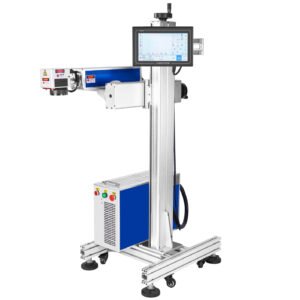
Flying Laser Marking Machines stand out as a core solution for industrial automation, designed specifically to handle high-speed production line needs. Notably, they mark metals, plastics, and ceramics in real time—no need to pause workflows—so production stays smooth and efficient. Additionally, they deliver crisp, durable marks, from serial numbers to logos, that resist wear and corrosion. Moreover, their compact design fits easily into existing lines, saving space while boosting productivity. Even more, they work with minimal operator input, cutting down on manual effort during long shifts.
First, these machines excel at adapting to fast-paced environments, a key reason Flying Laser Marking Machines are trusted in sectors like automotive and electronics. As a result, auto plants use them to mark parts mid-conveyor, keeping assembly lines moving. Furthermore, they offer adjustable marking speeds, matching the pace of different production runs. Besides, their high-precision lasers ensure consistency, even when handling small or intricate designs. Also, they integrate with line control systems, so operators monitor and adjust settings without disrupting work.
What’s more, Flying Laser Marking Machines prioritize long-term reliability for industrial use. Notably, their robust build handles continuous operation, reducing downtime for maintenance. Additionally, they use energy-efficient laser technology, lowering operational costs over time. Finally, they support multiple material types, making them versatile across different production needs. In short, they combine speed, precision, and durability—making them an essential tool for modern high-volume manufacturing.
A flying laser marking machine is a dynamic marking device capable of performing precise marking on products in high-speed motion (such as on conveyor belts) without stopping. It is ideal for mass production and automated manufacturing scenarios.
1. Key Features
- High-Speed Marking – Works in sync with conveyor line speeds, capable of marking hundreds to tens of thousands of products per minute (e.g., bottle caps, electronic components).
- Non-Contact – The laser does not physically touch the product, preventing damage and making it suitable for precision parts.
- High Precision – Positioning systems (such as visual recognition or photoelectric sensors) ensure that markings remain clear and stable even while in motion.
- Material Versatility – Can mark on metals, plastics, glass, ceramics, and more.
2. Common Laser Types
- Fiber Laser – Suitable for metals and hard plastics (e.g., stainless steel parts).
- CO₂ Laser – Ideal for non-metal materials (e.g., wood, glass, leather).
- UV Laser – Enables ultra-fine marking for high-precision applications (e.g., electronic components, brittle materials)